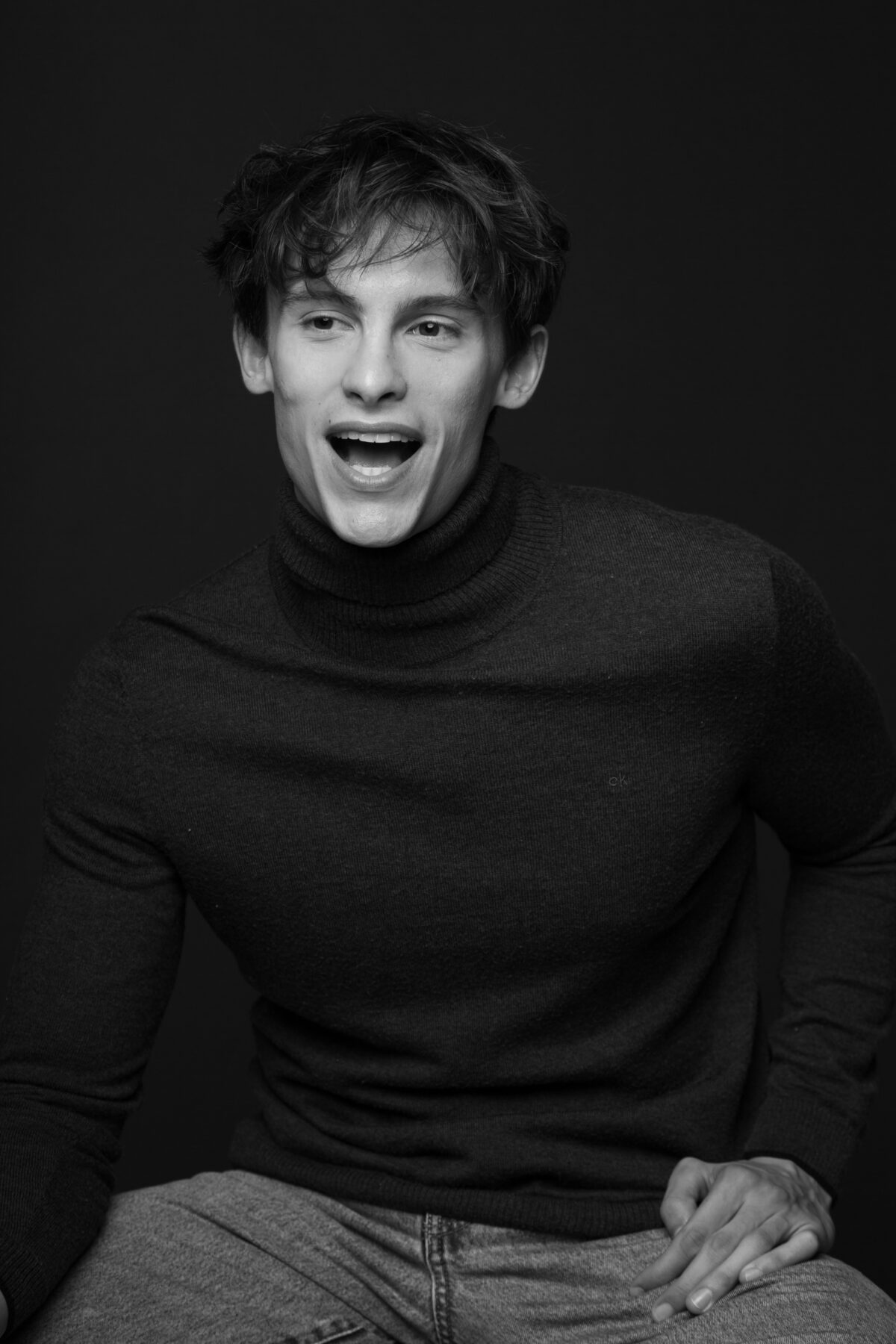
On transformation, instinct, and why the best actors never arrive
There’s a certain kind of actor who performs – and then there’s the kind who absorbs.
By the time I connected with Felix Merback, he was juggling production calls, navigating the early stages of building something much larger than himself, and – like the rest of us – trying not to get sick mid-shoot. It wasn’t a polished, media-trained moment. It was real. Slightly chaotic. Unfiltered.
Which, as it turns out, is exactly where Felix does his best work.
The Actor Who Doesn’t Want Comfort
Merback doesn’t speak about acting like a career. He speaks about it like a discipline – one rooted in repetition, failure, and constant recalibration.
“I don’t want to do the same thing over and over again,” he tells me. “That’s not interesting to me.”
There’s no hesitation in that statement. No hedging. Just clarity.
Trained in theater before transitioning to film, Felix describes his evolution as a process of both learning and unlearning – stripping away what doesn’t translate, rebuilding what does. It’s a mindset that has led him toward roles that differ not just in tone but also in psychological demand.
From unsettling, morally ambiguous characters to grounded, emotionally restrained leads, his choices reveal a deliberate rejection of typecasting.
What he’s chasing isn’t genre – it’s tension.
“I want something that challenges me,” he says. “Even if that means I fall flat on my face. That’s how you get better.”
The Switch: Stepping In – and Out – of Darkness
For actors who take on darker roles, there’s often a lingering question: how do you leave it behind?
For Felix, the answer is surprisingly precise.
“If I’ve done the work, I can click in and out,” he explains. “It’s like a light switch.”
That ability, he suggests, comes from an unusually direct access to his own emotional range—something he’s spent years refining. Not suppressing, but understanding.
There’s no romanticizing of suffering here. No performative “method” mythology.
Instead, there’s control.
And perhaps more importantly, responsibility.
Energy On Set: The Invisible Leadership
Felix is acutely aware of something many actors overlook: presence isn’t just about performance—it’s about impact.
“There’s a power to being at the top of the call sheet,” he says. “Your energy affects everyone.”
It’s a pragmatic philosophy. If you show up with ego, tension follows. If you show up grounded, collaborative, and open, the entire production shifts.
He chooses the latter.
Not because it’s expected – but because it’s effective.

A Medium in Motion: Vertical Storytelling
In a space often criticized for repetition, Felix is part of a small but growing group of actors pushing vertical storytelling beyond its perceived limits.
Where others settle into familiar archetypes, he’s actively seeking contrast – range that disrupts audience expectations rather than reinforces them.
“I don’t want to stay in one lane,” he says.
It’s a simple idea, but in a format built for speed and volume, it’s quietly radical.
Who He Wants to Work With Next
That forward momentum extends beyond the roles he chooses – it’s also reflected in the collaborators he’s drawn to.
When asked who he’d like to work with in the vertical space, Felix doesn’t hesitate.
Rebecca Stoughton and Tess Dinerstein are high on the list – actors he hasn’t yet shared the screen with but clearly respects. He also mentions Nick [Ritacco], someone he sees with strong creative potential, even entertaining the idea of dynamic roles that could flip between adversarial and romantic.
Jackson [Tiller] is another name he returns to – despite having worked together briefly, Felix is interested in a more fully realized collaboration.
What stands out isn’t just the names – it’s the intent.
He isn’t chasing visibility. He’s curating chemistry.

Influences: A Living Archive
Ask Felix who inspires him, and you won’t get a fixed list – you’ll get a system.
“I’m influenced by what I’m watching in the moment,” he says. “It all goes into the toolkit.”
Right now, that toolkit includes the calculated unraveling of Bryan Cranston in Breaking Bad, the unsettling precision of Jake Gyllenhaal in Nightcrawler, and the near-mythic transformation of Daniel Day-Lewis.
But just as often, inspiration comes from something smaller – a single moment of truth from an unexpected source.
“That’s what I love,” he says. “When something just feels real.”
The Soundtrack Behind the Work
That same sense of absorption extends beyond film.
Music, for Felix, isn’t background noise – it’s another entry point into emotion, rhythm, and tone.
His taste is as eclectic as his roles.
From the atmospheric storytelling of Glass Animals to the timeless introspection of Pink Floyd, his influences move fluidly between eras and genres. Amy Winehouse’s raw vulnerability, the eccentric unpredictability of Primus, and the lyrical precision of JID round out a list that reflects both depth and range.
It’s not a curated aesthetic – it’s a reflection of how he processes the world.
And much like his acting, it resists easy categorization.
Drawn to the Edge
Felix’s early exposure to film wasn’t curated – it was exploratory. Sometimes chaotic. Often provocative.
From Stephen King adaptations to psychologically intense cult classics, he found himself less interested in comfort than in boundaries.
“I was always fascinated by how far you could take something,” he admits.
Not for shock value – but for possibility.
What happens when a story pushes past expectation? What lives on the other side of that line?
For Felix, those questions aren’t theoretical. They’re foundational.
Beyond Acting: Building Something That Lasts
That same curiosity is now extending into production.
Through his work with Full Moon Features, Felix is helping develop original vertical content that aims to bridge the gap between traditional filmmaking and the rapidly expanding digital-first landscape.
The goal isn’t just to participate in the space – but to reshape it.
“We want to tell stories that feel different,” he says. “Something that doesn’t alienate the audience – but also doesn’t underestimate them.”
It’s a careful balance. And one he seems intent on getting right.
The Mindset: Never Finished
If there’s a throughline to everything Felix says, it’s this:
He doesn’t believe in arrival.
“I don’t ever want to think, ‘I’ve made it,’” he says. “I always want to keep growing.”
There’s no false humility in that. Just awareness.
Because for actors like Felix Merback, the work isn’t about reaching a peak.
It’s about staying in motion.

The Prediction
There’s a moment, late in our conversation, where I tell him what I tell very few people:
He’s going to be on a much bigger stage one day.
Not hypothetically. Not aspirationally. Inevitably.
He laughs – but not dismissively.
“Then you’re getting a plus-one ticket,” he says.
I’ll hold him to that.
Because if there’s one thing I’ve learned after years of doing this – it’s that you can tell who’s just performing…and who’s becoming.
Connect with Felix on Instagram
Related Interviews:
Eric Taylor Guilmette on Creative Risk, Vertical Storytelling, & the Power of Staying Curious
An Intimate Conversation with Autumn Noel: Craft, Creativity, and the Future of Vertical Storytelling
Kasey Esser on Vertical Storytelling, Micro-Dramas, and Acting for the Phone Screen
A Candid Encounter: Haley Lohrli on the Whirlwind of Micro-Dramas, Personal Reinvention, and the Art of Authenticity